
Ahmad Fatan Nurulhuda
Feed is the single biggest cost in fish farming, often accounting for 40 to 70 percent of total production expenses. Across African countries where aquaculture is expanding and playing an important role in improving food security, nutrition and livelihoods, these high feed costs remain a major constraint on the sector’s growth and profitability.
A key reason for these high costs is that many feed producers rely on imported ingredients, which makes feeds more expensive and reduces the profitability of fish farming, particularly for small-scale producers. To address this challenge, the WorldFish-led Development and Scaling of Sustainable Feeds for Resilient Aquatic Food Systems in Sub-Saharan Africa (FASA) project aims to identify, evaluate, and promote locally available, cost-effective, and nutritious feed ingredients across Sub-Saharan Africa. As part of this effort, the project is conducting comprehensive laboratory analyses and digestibility trials on locally sourced ingredients from Kenya, Nigeria, and Zambia. Key parameters to be evaluated include proximate composition, the presence of anti-nutritional factors, and apparent digestibility coefficients (ADCs) of nutrients.
The resulting data will provide critical insights into the nutritional potential and limitations of each ingredient. Ultimately, these findings will inform the development of locally adapted fish feed formulations, and will be disseminated publicly to support wider adoption and impact.
What are Digestibility Experiments?
Digestibility experiments are conducted to evaluate how efficiently fish can digest and utilize nutrients from different feed ingredients. Even if a raw material contains high levels of nutrients such as protein or energy, its actual nutritional value in aquafeeds depends on the extent to which these nutrients can be digested and absorbed by the fish. Digestibility assessments are, therefore, essential for determining the bioavailability of nutrients and the suitability of ingredients for inclusion in aquaculture feed formulations.
These experiments measure key parameters, including the apparent digestibility coefficients (ADCs) of protein, energy, and other nutrients. The resulting data provide crucial insights into nutrient utilization efficiency and help determine whether locally available raw materials can partially or fully replace commonly used imported feed ingredients.
Digestibility Experiments in Malaysia
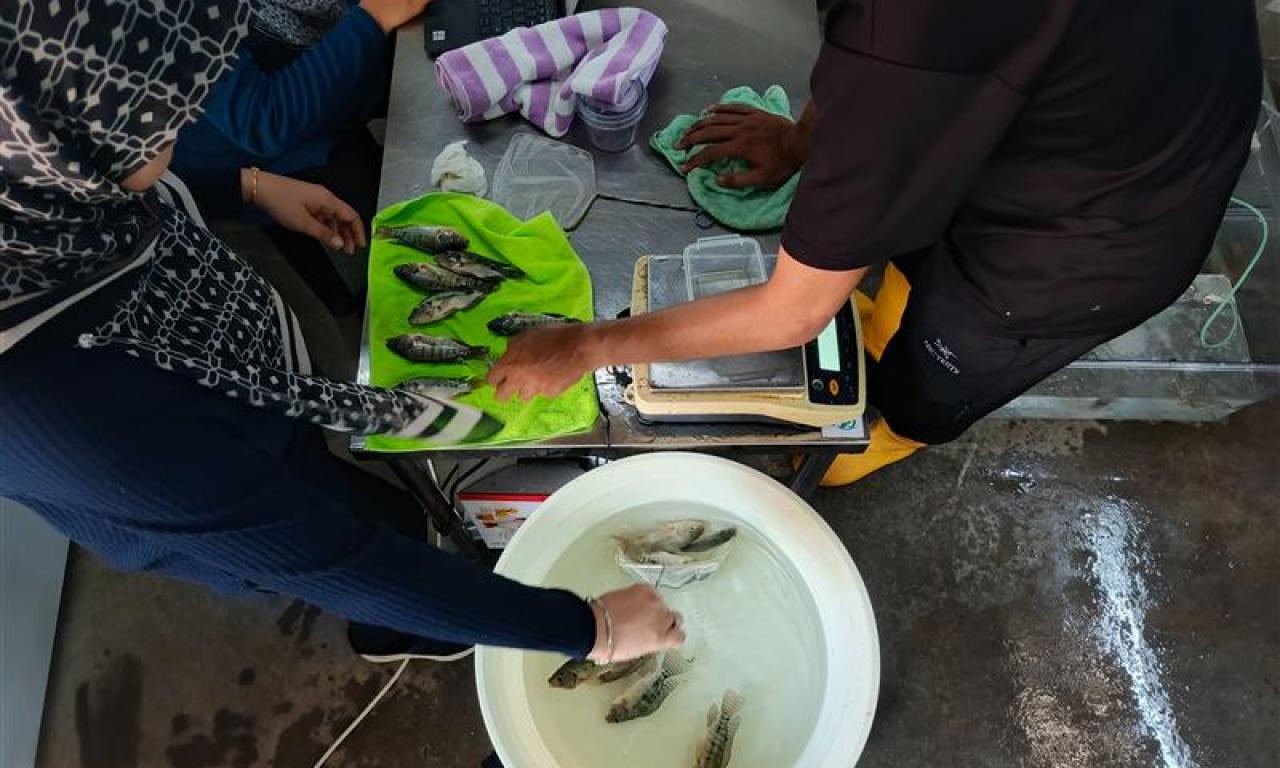
A series of digestibility experiments is currently underway at Universiti Sains Malaysia (USM) in Penang under controlled laboratory conditions. These trials are evaluating a range of locally sourced ingredients collected from FASA partner countries: Zambia, Kenya, and Nigeria. The ingredients, ranging from animal-based to plant-based materials and agro-industrial waste, were selected based on ingredient scoping studies in the target countries. While many are readily available locally, their nutritional value and suitability for aquafeeds remain largely uncharacterized.
To date, WorldFish has conducted six digestibility experiments as part of this initiative. Standard digestibility protocols are being applied using GIFT (Genetically Improved Farmed Tilapia) as the experimental species. Experimental diets are formulated by incorporating the test ingredient into a reference diet, along with an inert marker consisting of a substance that is not digested or absorbed by the fish. This marker passes through the digestive system and is measured in the faeces. By comparing its concentration in the diet and in the faeces, researchers can estimate how much of the nutrient from the test ingredient is digested and absorbed. This allows the determination of nutrient digestibility and an assessment of the overall nutritional value of the ingredient.
The data generated from these experiments provide valuable insights into the nutritional potential of locally available feed ingredients. They also help build the evidence base for a digital feed formulation tool being developed in FASA’s final phase, designed to support feed decisions by farmers, feed producers and extension services.
By improving understanding of how these ingredients perform, the findings can inform their use in feed formulations. In this way, the work contributes to translating research into practical guidance that can be applied across different country contexts.
Cover photo: Researchers conduct digestibility experiments at Universiti Sains Malaysia in Penang to evaluate the nutritional value of locally sourced feed ingredients. Photo: WorldFish